
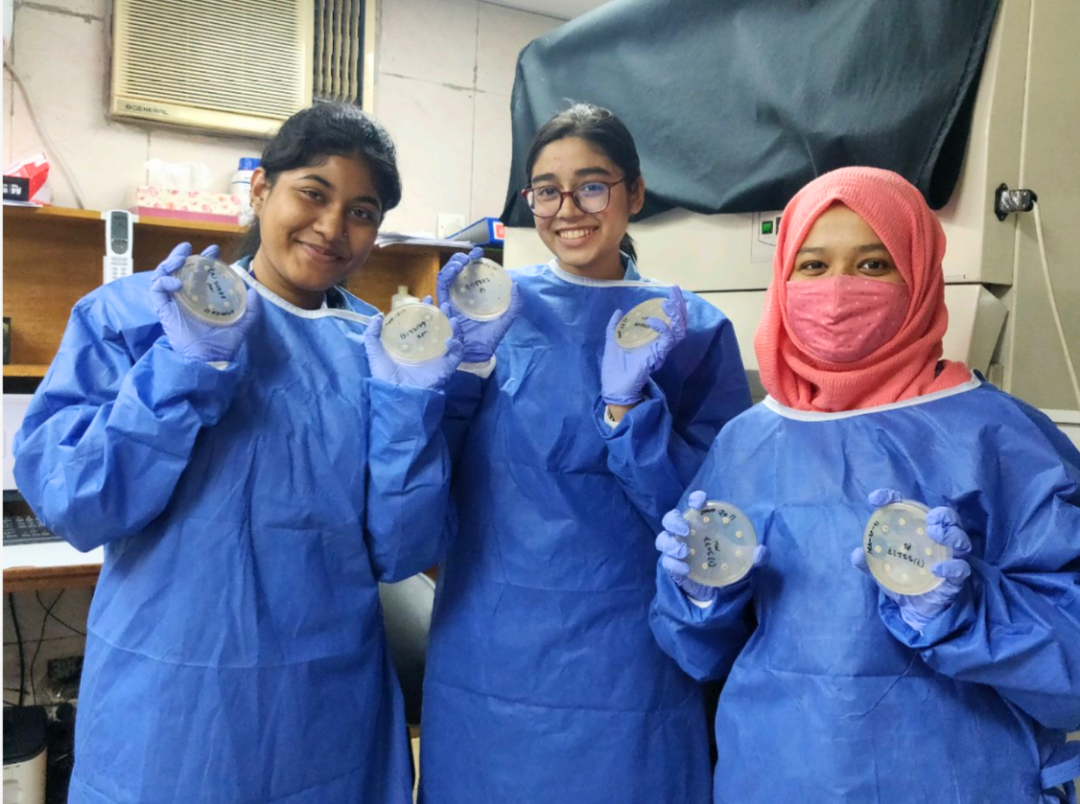
Antimicrobial resistance (AMR) is a growing global health crisis, threatening the effectiveness of medicines used to treat infections and putting millions of lives at risk. Understanding how resistance develops and evolves in microbes is essential to finding effective ways to address this challenge.
At CHRF, we have been studying antimicrobial resistance in Bangladesh since the 1990s. Our research has explored antibiotic resistance in several bacterial pathogens, including Salmonella Typhi, Salmonella Paratyphi A, Klebsiella pneumoniae and Streptococcus pneumoniae. Through research, genomic surveillance and collaborations with national and international partners, we continue to investigate emerging resistance patterns, understand their genetic basis and examine their impact on public health.
Our work also highlights the importance of prevention, surveillance and continued research in preserving the effectiveness of life-saving medicines. The following publications highlight CHRF's contributions to AMR research over the years:
2026
- Escalating burden and mortality of carbapenem-resistant Klebsiella pneumoniae species complex infections in Bangladeshi infants
NPJ Antimicrobials and Resistance
2025
- Outbreak of Ceftriaxone-Resistant Salmonella enterica Serovar Typhi, Bangladesh, 2024
Emerging Infectious Diseases
2024
- Estimating the subnational prevalence of antimicrobial resistant Salmonella enterica serovars Typhi and Paratyphi A infections in 75 endemic countries, 1990–2019: a modelling study
The Lancet Global Health - Trends in antimicrobial resistance amongst Salmonella Typhi in Bangladesh
PLOS Neglected Tropical Diseases - A Collective Commitment: Tackling Antimicrobial Resistance in Low- and Middle-Income Countries.
Nature - Tackling antimicrobial resistance needs a tailored approach — four specialists weigh in
Nature - Antimicrobial resistance: action must shift towards prevention
BMJ - Using digital health technologies to optimise antimicrobial use globally
THE LANCET Digital Health
2023
- Trends in antimicrobial resistance amongst Salmonella Paratyphi A isolates in Bangladesh: 1999–2021
PLOS Neglected Tropical Diseases - Global diversity and antimicrobial resistance of typhoid fever pathogens: Insights from a meta-analysis of 13,000 Salmonella Typhi genomes
eLife
2022
- The international and intercontinental spread and expansion of antimicrobial-resistant Salmonella Typhi: a genomic epidemiology study.
Lancet Microbe - Emergence of a multidrug-resistant and virulent Streptococcus pneumoniae lineage mediates serotype replacement after PCV13: an international whole-genome sequencing study.
Lancet Microbe. - Salmonella enterica Serovar Typhi on an Island: No H58, No Multidrug Resistance, but for How Long?
mBio
2021
- Typhoid Conjugate Vaccine: An Urgent Tool to Combat Typhoid and Tackle Antimicrobial Resistance.
The Journal of Infectious Diseases - Antimicrobial susceptibilities and comparative whole genome analysis of two isolates of the probiotic bacterium Lactiplantibacillus plantarum, strain ATCC 202195.
Scientific Reports - Correction for Tanmoy et al., "Salmonella enterica Serovar Typhi in Bangladesh: Exploration of Genomic Diversity and Antimicrobial Resistance".
mBio - Tracking the Emergence of Azithromycin Resistance in Multiple Genotypes of Typhoidal Salmonella.
mBio - The role of interspecies recombination in the evolution of antibiotic-resistant pneumococci.
ELife
2020
- Antimicrobial Resistance in Typhoidal Salmonella: Around the World in 3 Days.
Clinical Infectious Diseases - Antimicrobial Resistance in Typhoidal Salmonella: Surveillance for Enteric Fever in Asia Project, 2016-2019.
Clinical Infectious Diseases - A mosaic tetracycline resistance gene tet(S/M) detected in an MDR pneumococcal CC230 lineage that underwent capsular switching in South Africa.
The Journal of Antimicrobial Chemotherapy - Mass azithromycin administration: considerations in an increasingly resistant world.
BMJ Global Health - A Race against Time: Reduced Azithromycin Susceptibility in Salmonella enterica Serovar Typhi in Pakistan.
mSphere
2019
- Typhoid conjugate vaccines: a new tool in the fight against antimicrobial resistance.
The Lancet. Infectious Diseases - Analysis of isolates from Bangladesh highlights multiple ways to carry resistance genes in Salmonella Typhi.
BMC Genomics - Effect of carbapenem resistance on outcomes of bloodstream infection caused by Enterobacteriaceae in low-income and middle-income countries (PANORAMA): a multinational prospective cohort study.
The Lancet. Infectious Diseases - Molecular mechanism of azithromycin resistance among typhoidal Salmonella strains in Bangladesh identified through passive pediatric surveillance.
PLoS Neglected Tropical Diseases - Pneumococcal lineages associated with serotype replacement and antibiotic resistance in childhood invasive pneumococcal disease in the post-PCV13 era: an international whole-genome sequencing study
The lancet. Infectious diseases - Urinary tract infections in pregnancy in a rural population of Bangladesh: population-based prevalence, risk factors, etiology, and antibiotic resistance.
BMC Pregnancy and Childbirth
2018
- Salmonella enterica Serovar Typhi in Bangladesh: Exploration of Genomic Diversity and Antimicrobial Resistance.
mBio - Ceftriaxone-resistant Salmonella Typhi carries an IncI1-ST31 plasmid encoding CTX-M-15.
Journal of Medical Microbiology
2017
- Detection of macrolide resistance genes in culture-negative specimens from Bangladeshi children with invasive pneumococcal diseases.
Journal of Global Antimicrobial Resistance
2009
- Surveillance for invasive Streptococcus pneumoniae disease among hospitalized children in Bangladesh: antimicrobial susceptibility and serotype distribution.
Clinical Infectious Diseases
2006
- Molecular basis of resistance displayed by highly ciprofloxacin-resistant Salmonella enterica serovar Typhi in Bangladesh.
Journal Of Clinical Microbiology
2005
- Invasive Haemophilus influenzae type B diseases in Bangladesh, with increased resistance to antibiotics.
The Journal of Pediatrics
2003
- Comparison of antibiotic resistance and serotype composition of carriage and invasive pneumococci among Bangladeshi children: implications for treatment policy and vaccine formulation.
Journal of Clinical Microbiology
1999
- Antimicrobial Resistance and Serotype Distribution of Streptococcus pneumoniae Strains Causing Childhood Infections in Bangladesh, 1993 to 1997.
Journal of Clinical Microbiology - A highly ceftriaxone-resistant Salmonella typhi in Bangladesh.
The Pediatric Infectious Disease Journal
1997
- Decreasing trend of multiresistant Salmonella typhi in Bangladesh.
The Journal of Antimicrobial Chemotherapy
1995
- Emergence of high-level fluoroquinolone-resistant Escherichia coli in Bangladesh.
International Journal of Antimicrobial Agents
1994
1991